
Periodic Electrical Inspections & PIR (EICR)
A Periodic Inspection Report (PIR) on an existing installation, with findings explained plainly. EICR is a commonly searched term for electrical condition inspections.
What a periodic inspection actually involves
A periodic inspection is a structured examination and test of an existing installation: the board and protective devices, earthing and bonding, a sampled inspection of accessories and fittings, and dead and live testing, insulation resistance, continuity, polarity, earth loop impedance and RCD operation. It produces a report listing what was inspected, what was tested and what's wrong, with each defect coded by seriousness.
Following inspection and testing, the Periodic Inspection Report records the condition of the installation, identifies defects or non-compliances and sets out the recommended action required. Safe Electric’s PIR system uses recommendations ranging from items requiring urgent attention through to matters that do not comply with the current National Rules but do not necessarily make the installation unsafe.
We report what we find and nothing else. If an installation is sound, the report says so, a clean report is a perfectly good outcome and we don't invent items to generate remedial work. Where remedials are needed they're quoted separately so you can compare, and we're happy for you to have someone else do them.
- Board, earthing and bonding inspection with sampled accessory checks
- Full dead and live testing with recorded results
- Every defect coded and explained in plain English
- Remedial work quoted separately, never bundled in
- Written report suitable for landlords, buyers and insurers
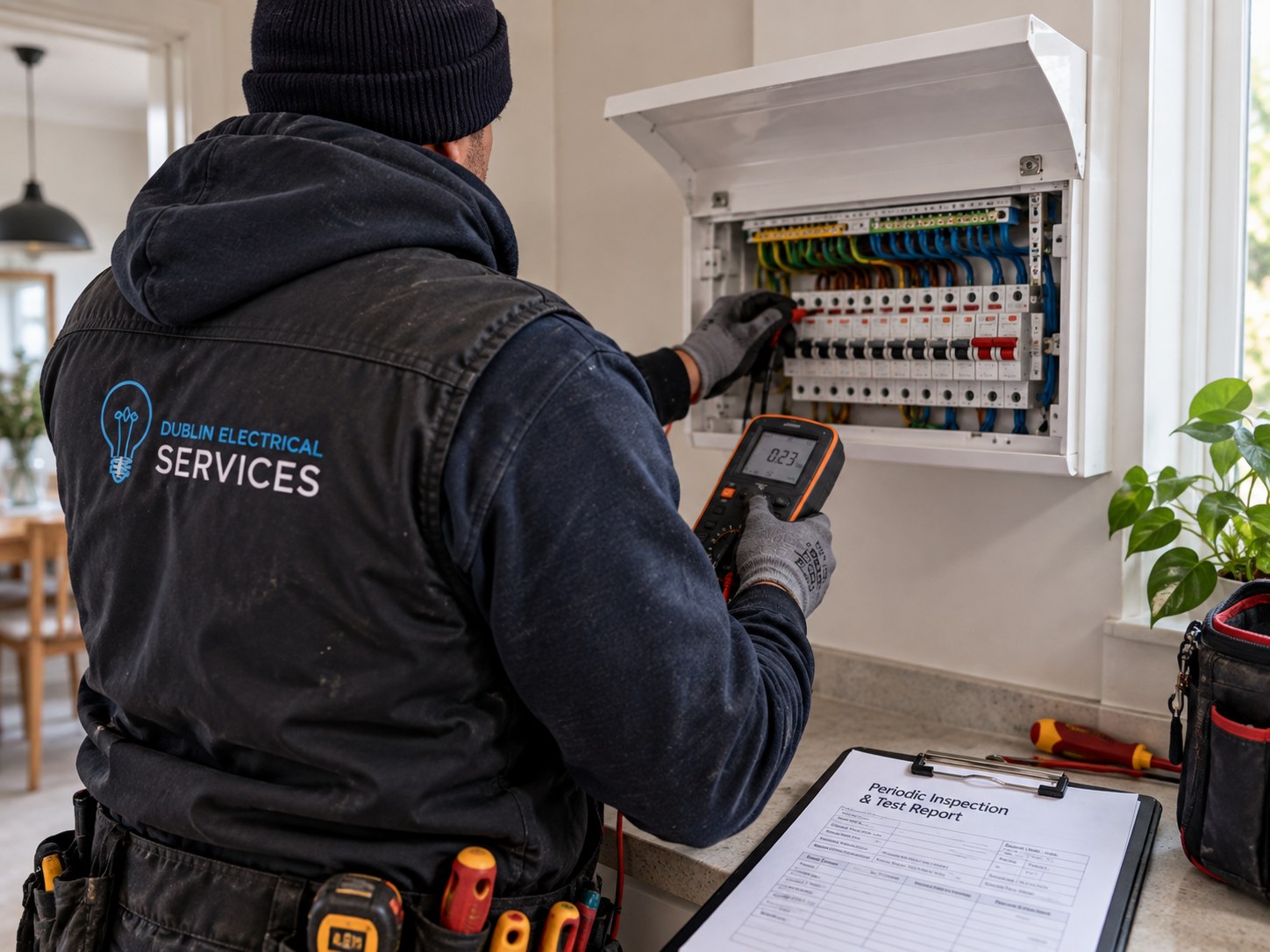
Electrical Inspection and EICR in Cabinteely, Dublin
A recent periodic electrical inspection in Cabinteely, Dublin involved testing the installation at the consumer unit and recording the condition of the electrical system. An EICR assesses more than whether sockets and lights are working, with circuits, protective devices, earthing, bonding and test results forming part of the inspection.
Dublin Electrical Services carries out periodic electrical inspections and EICR testing in Cabinteely and across Dublin for homeowners, landlords, property managers and businesses. Where testing identifies follow-up work, our remedial electrical work can address it.
Common questions
- How often should an installation be inspected?
- As a general rule around every ten years for an owner-occupied home, five years or change of tenancy for a rental, and shorter intervals for commercial premises. Any installation being bought, let or significantly altered is worth inspecting regardless of date.
- Will the power be off during the inspection?
- Partly. Dead testing needs circuits isolated, so expect the power off in blocks rather than all day. We work around anything critical if you tell us in advance.
- What happens if something dangerous is found?
- We make it safe there and then, usually isolating the affected circuit, and explain what it will take to repair. You're never left with a live danger and a report telling you about it.
- Does a failed report mean a rewire?
- Rarely. Most reports come back with a handful of specific items, a missing bond, a damaged accessory, no RCD on a shower circuit, and those are targeted repairs. A rewire only comes up when the cable itself is at the end of its life.
Areas we cover
We carry out this work across Dublin city and county. Several core areas around our south Dublin base have dedicated local pages:
- electrician in Shankill
- electrician in Ballybrack
- electrician in Cabinteely
- electrician in Dún Laoghaire
- electrician in Blackrock
- electrician in Stepaside
- electrician in Dundrum
These dedicated pages show some of the work and services relevant to each area rather than limiting where we work. See the full list of areas we cover across Dublin, and ring us if your area is not listed.
Need someone today?
Describe the symptom rather than the solution and we'll tell you honestly whether it needs an emergency visit or a booked appointment. Emergency call-outs are prioritised.