
PAT Testing
Portable appliance testing with usable records, asset list, pass/fail results and labels, sized to your premises rather than a fixed package.
What PAT testing actually involves
PAT testing is a visual inspection plus electrical tests on anything that plugs in: earth continuity, insulation resistance and, where it applies, a lead polarity and functional check. In practice the visual inspection catches most real problems, crushed leads, cracked plugs, taped-up joints, kettle leads run under a chair castor, extension blocks daisy-chained under a desk, and the instrument confirms what the eye can't see.
The output matters as much as the testing. You get an asset register with each item identified and located, individual pass or fail results, a label on each appliance with the test date, and a summary of anything failed or removed from service. That's what an insurer or an auditor actually asks to see. Failed items are labelled and taken out of use rather than left plugged in with a note.
We work around occupancy in offices, shops, rentals, salons and community premises, early mornings or after hours where testing during trading hours isn't realistic. Intervals depend on the equipment and environment: hand-held gear on a building site needs testing far more often than a printer that hasn't moved in three years, and we'll advise on a sensible schedule instead of blanket-testing everything annually.
- Visual inspection plus earth continuity and insulation testing
- Asset register with location and individual results
- Dated pass labels on each appliance tested
- Failed items labelled and removed from service
- Advice on realistic retest intervals per equipment type
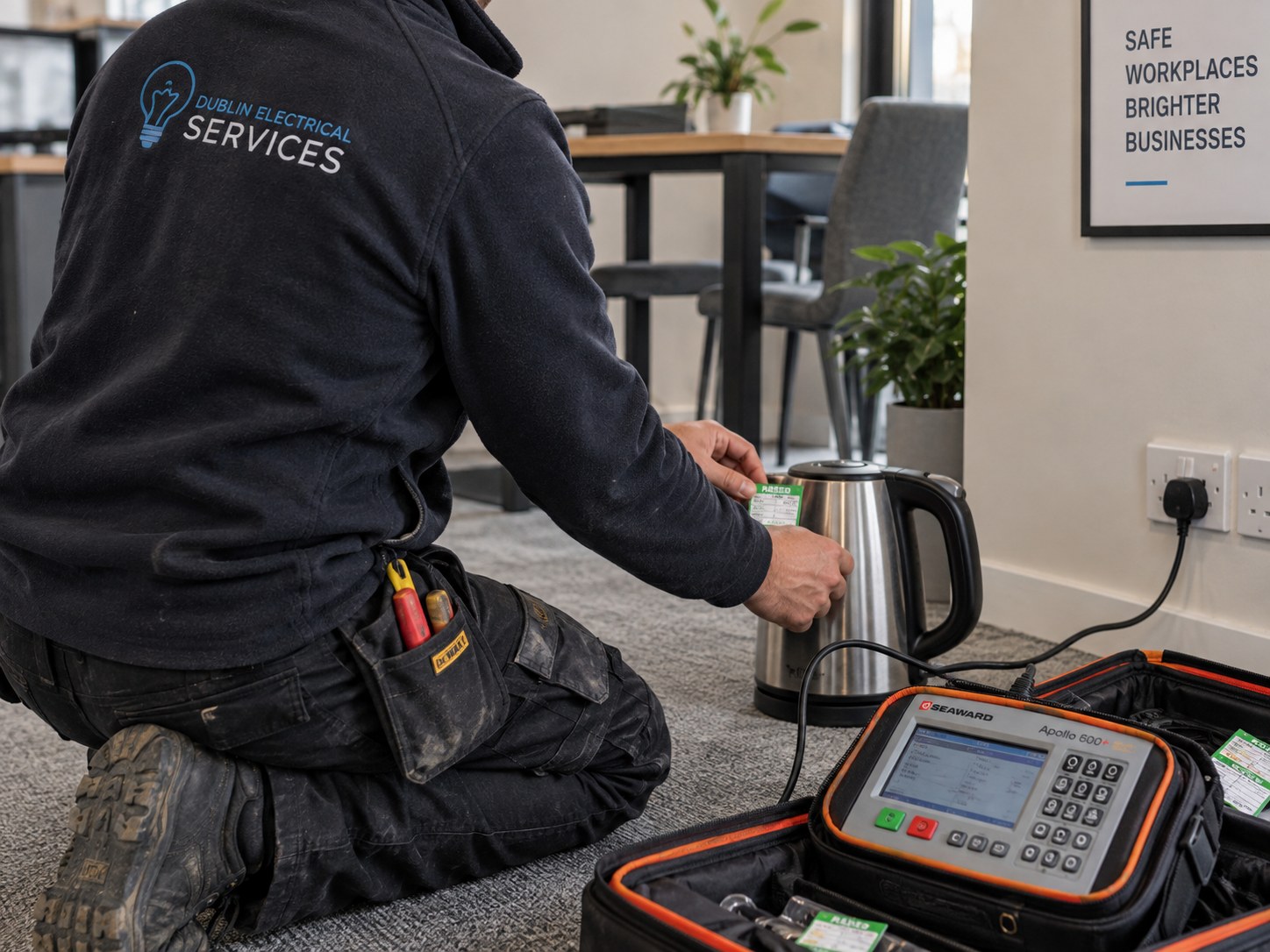
PAT Testing in Dundrum, Dublin
Recent PAT testing work in Dundrum, Dublin involved checking portable electrical equipment in a working business environment and recording the individual results. Appliances are visually checked and electrically tested where appropriate so the business has a useful record of the equipment assessed.
Dublin Electrical Services provides PAT testing in Dundrum and across Dublin for offices, shops, salons, workshops and other commercial premises.
Common questions
- Is PAT testing a legal requirement?
- There is not one blanket rule requiring every electrical appliance to be PAT tested on the same schedule. Employers are responsible for keeping electrical equipment safe, and equipment exposed to wear, damage or other deterioration may require periodic inspection and testing by a competent person. The appropriate checks and intervals depend on the equipment, how it is used and the environment it is used in.
- How often does equipment need testing?
- It depends on use and environment rather than a single rule. Hand-held and site tools need frequent checks, office equipment far less. We'll set out an interval per equipment type rather than testing everything on the same cycle.
- Do you need to shut the business down?
- No. Each appliance is only unplugged for a couple of minutes, and we schedule around trading, before opening, after close, or department by department.
- What happens to items that fail?
- They're labelled as failed, taken out of service and listed in the report. Where it's a repairable fault, a lead or a plug, we'll tell you, and often fix it on the spot.
Areas we cover
We carry out this work across Dublin city and county. Several core areas around our south Dublin base have dedicated local pages:
- electrician in Shankill
- electrician in Ballybrack
- electrician in Cabinteely
- electrician in Dún Laoghaire
- electrician in Blackrock
- electrician in Stepaside
- electrician in Dundrum
These dedicated pages show some of the work and services relevant to each area rather than limiting where we work. See the full list of areas we cover across Dublin, and ring us if your area is not listed.
Need someone today?
Describe the symptom rather than the solution and we'll tell you honestly whether it needs an emergency visit or a booked appointment. Emergency call-outs are prioritised.