
Electrical Troubleshooting & Fault Finding
Tripping breakers, dead circuits and faults that come and go, traced back to the actual cause instead of swapped parts and guesswork.
What fault-finding actually involves
Fault-finding is a diagnostic job. We split the installation down, test circuit by circuit and prove where the fault sits before anything is replaced, insulation resistance, continuity, polarity, loop impedance and RCD tests, plus the unglamorous part of unplugging things and watching what happens. The point is to end up with evidence, not a theory.
Most faults fall into a handful of patterns. An RCD that trips at the same time every day is usually an immersion, shower or outside circuit with moisture in it. A breaker that trips under load is often an overloaded circuit or a failing connection generating heat. Intermittent faults that follow the weather are almost always water finding its way into external lights, sockets or a junction box. Dead sockets in a run usually come back to one loose terminal, not a dead cable.
Intermittent faults are the ones other electricians walk away from, and they're the work we get called in for most. Where a fault genuinely won't present itself on the day, we say so and set up the tests needed to catch it rather than replacing parts on the off chance. You get told what we found, what we ruled out, and what it will take to fix.
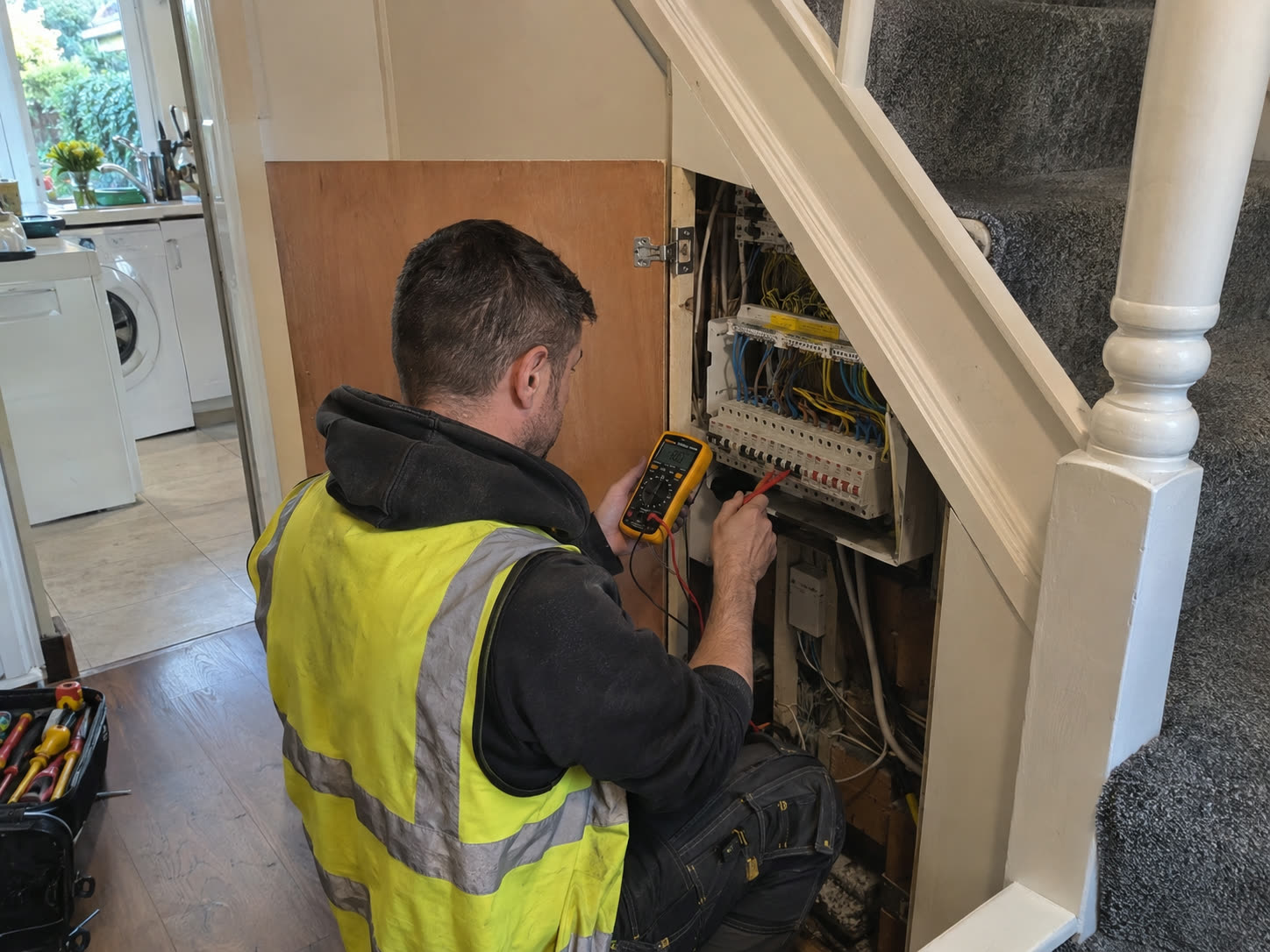
Electrical testing and fault diagnosis being carried out at a residential property in Dublin.
- Systematic circuit-by-circuit testing, not parts swapping
- Faulty appliances identified as well as faulty wiring
- Findings explained plainly, including what was ruled out
- Repair quoted before it's carried out
- Test results recorded and certification where work is notifiable
Common questions
- Why does my breaker keep tripping?
- Usually one of three things: too much load on the circuit, a damaged or wet cable or accessory, or a faulty appliance plugged into it. Resetting it repeatedly won't tell you which, testing will, and it's the only way to know whether it's an appliance you can unplug or wiring that needs work.
- Is a tripping RCD dangerous?
- The RCD tripping is the safety device doing its job, so that part is good news. What it's telling you, an earth fault, moisture in a circuit, deteriorating insulation, does need finding. Leaving it tripping and resetting means living with an unresolved fault.
- How long does fault-finding take?
- Straightforward faults are often found within the first hour. Intermittent ones can take longer because the fault has to be present to be measured. We give you a time estimate up front and keep you updated rather than running the clock quietly.
- Do you fix the fault on the same visit?
- Where the repair is small, a failed socket, a burnt terminal, a faulty light fitting, yes, usually on the spot. Bigger repairs like a damaged buried cable or a board replacement get quoted first, and we make the installation safe in the meantime.
Areas we cover
We carry out this work across Dublin city and county. Several core areas around our south Dublin base have dedicated local pages:
- electrician in Shankill
- electrician in Ballybrack
- electrician in Cabinteely
- electrician in Dún Laoghaire
- electrician in Blackrock
- electrician in Stepaside
- electrician in Dundrum
These dedicated pages show some of the work and services relevant to each area rather than limiting where we work. See the full list of areas we cover across Dublin, and ring us if your area is not listed.
Need someone today?
Describe the symptom rather than the solution and we'll tell you honestly whether it needs an emergency visit or a booked appointment. Emergency call-outs are prioritised.